How to use the Circuit Breaker?

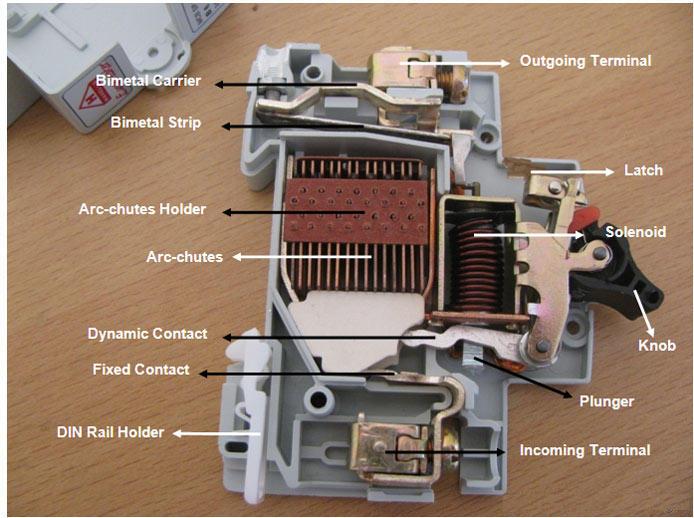
There are three mechanisms provided in a single miniature circuit breaker to make it switched off. If we carefully observe the picture beside, we will find there are mainly one bi – metallic strip, one trip coil and one hand operated on – off lever.

Electric electric current carrying path of a miniature circuit breaker shown in the picture is like follows:

-First left hand side power terminal

-Secondly bimetallic strip

– Then electric current coil or trip coil

-Then moving contact – then fixed contact

-Lastly right had side power terminal. All are arranged in series.

How to reset a circuit breaker or trip?

There are two contacts one is fixed and the other moveable. When the current exceeds the predefined limit a solenoid forces the moveable contact to open (i.e., disconnect from the fixed contact) and the MCB turns off thereby stopping the current to flow in the circuit.

In order to restart the flow of current the MCB is manually turned on. This mechanism is used to protect from the faults arising due to over current or over load.

To protect against fault arising due to over heating or increase in temperature a bi-metallic strip is used. MCBs are generally designed to trip within 2.5 millisecond when an over current fault arises. In case of temperature rise or over heating it may take 2 seconds to 2 minutes for the MCB to trip.

MCB Internal Part


How to Choose the Right Circuit Breaker?

Circuit breakers protect your house from dangerous power overloads. This guide helps you pick what best fits your needs.

Meba Circuit BreakerCircuit breakers are a very important part of electrical safety. They control the amount of electricity that is allowed to flow through a building’s wiring system. If your building suffers an electric overload, a properly functioning circuit breaker will detect this and cut off the electricity so that your appliances and wires are protected until you can restart the electricity. However, in order for a circuit breaker to do its job, you have to match the right circuit breaker with your exact needs. The following simple explanations and rules will have you ready to choose the appropriate circuit breaker in no time.


Different Types of Circuit Breakers:
Every circuit breaker is made to accommodate a specific amount of electricity. Most homes require low-voltage magnetic circuit breakers that only allow for electrical currents that measure up to 1000 amps. Medium voltage circuit breakers are used in larger buildings and businesses that use up to 72,000 volts on a regular basis. High-voltage circuit breakers are used alongside power lines and other places that use more than 72,000 volts regularly. (Most Networx readers will need low-voltage magnetic circuit breakers to complete their DIY projects.)

Figuring out the Correct Breaker Size:
In order to choose the best-sized circuit breaker for your particular needs, you will need to check the wire size printed on the cable that will be connected to the circuit breaker. There will be two measurements listed: The first will tell you the wire gauge and then there will be a dash and a number indicating how many wires are inside the cable. Once you have established the wire gauge, you can use the following chart to pick the correct circuit breaker:

8-gauge wire = 40-amp circuit breaker
10-gauge wire = 30-amp circuit breaker
12-gauge wire = 20-amp circuit breaker
14-gauge wire = 15-amp circuit breaker

How Does It Work?
Low-voltage circuit breakers have two safety mechanisms that keep your appliances from getting fried by electric overloads. The first is an electromagnet that immediately shuts off the electrical current when it senses a large electric surge. The second safety mechanism is operated by a thermal metallic strip that bends and trips a switch into the “Off” position when too much heat is applied by a prolonged electrical surge. To read more about thermal magnetic circuit breakers, check out this article on Electricians Networks.

Electrical work must always be done with your safety as the top priority. If you have any questions or confusion about choosing the right circuit breaker for your project, talk to an expert at your local hardware store or call an experienced electrician to get some sound advice.

What is the Circuit Breaker?

A Circuit Breaker is an automatically operated electrical switch designed to protect an electrical circuit from damage caused by overload or short circuit. Its basic function is to detect a fault condition and interrupt current flow. Unlike a fuse, which operates once and then must be replaced, a circuit breaker can be reset (either manually or automatically) to resume normal operation.

Circuit breakers are made in varying sizes, from small devices that protect an individual household appliance up to large switchgear designed to protect high voltage circuits feeding an entire city.

Operation:

1. All circuit breaker systems have common features in their operation, although details vary substantially depending on the voltage class, current rating and type of the circuit breaker.
The circuit breaker must detect a fault condition; in low voltage circuit breakers this is usually done within the breaker enclosure. Circuit breakers for large currents or high voltages are usually arranged with protective relay pilot devices to sense a fault condition and to operate the trip opening mechanism.

2. Once a fault is detected, contacts within the circuit breaker must open to interrupt the circuit; some mechanically-stored energy (using something such as springs or compressed air) contained within the breaker is used to separate the contacts, although some of the energy required may be obtained from the fault current itself. Small circuit breakers may be manually operated, larger units have solenoids to trip the mechanism, and electric motors to restore energy to the springs.

3. The circuit breaker contacts must carry the load current without excessive heating, and must also withstand the heat of the arc produced when interrupting (opening) the circuit. Contacts are made of copper or copper alloys, silver alloys and other highly conductive materials. Service life of the contacts is limited by the erosion of contact material due to arcing while interrupting the current. Miniature and molded-case circuit breakers are usually discarded when the contacts have worn, but power circuit breakers and high-voltage circuit breakers have replaceable contacts.

4. When a current is interrupted, an arc is generated. This arc must be contained, cooled and extinguished in a controlled way, so that the gap between the contacts can again withstand the voltage in the circuit. Different circuit breakers use vacuum, air, insulating gas or oil as the medium the arc forms in. Different techniques are used to extinguish the arc including:
-Lengthening / deflection of the arc
-Intensive cooling (in jet chambers)
-Division into partial arcs
-Zero point quenching
-Connecting capacitors in parallel with contacts in DC circuits.
Finally, once the fault condition has been cleared, the contacts must again be closed to restore power to the interrupted circuit.

Types of circuit breaker:
1 Low-voltage circuit breakers
2 Magnetic circuit breakers
3 Thermal magnetic circuit breakers
4 Common trip breakers
5 Medium-voltage circuit breakers
6 High-voltage circuit breakers
7 Sulfur hexafluoride (SF6) high-voltage circuit breakers
8 Disconnecting circuit breaker (DCB)
9 Carbon dioxide (CO2) high-voltage circuit breakers